

My Neurotypical Alter Ego
It doesn't always work, but it's fun while it lasts

Hi, disclaimer. I am a human living with ADHD with no training or credentials to do anything more than talk about my own life and experiences. The following is based on my lived experience and how I’ve learned to live with and work with my ADHD and nothing more. This is not intended to be advice, and if you feel you need it, I'd encourage (but not advise!) you to talk to a professional.
One day,1 while browsing Substack notes (as one does), I came across a brilliant tidbit from Anna Seirian that I haven’t been able to stop thinking about.
“I think I just changed my life,” she says.
Anna, I think you changed mine, too.
The idea of creating a version of yourself that just does the thing you want it to feels so simple, and yet so revolutionary.
Those of us who have ADHD have probably heard someone, whether it be our doctors, therapists, friends, or other ADHDers online, talk about the importance of having a ‘toolbox’ to deal with ADHD symptoms: that is, having strategies, processes, and other ways of working when navigating the everyday feels tough. This is not novel, and is something recommended by most — awareness and medication, while monumental, are very often not enough. We need tangible ways of working.
Some of the most popular strategies that I personally have in my toolbox are: working via timers (Pomodoro timers, where you work for 25 minutes and rest for 5, are especially popular), body doubling (or working with others in community), opening the dishwasher and telling myself I only have to put one mug away when I need to empty it (or lowering the stakes of whatever is on my to do list to the most absolute bare-minimum version of it), putting my phone behind my laptop screen while working, and more. I have bare minimum workout and skincare routines, and have been known to fold one t-shirt before calling it quits.
Others store their vegetables in their refrigerator door and put the condiments in the crisper so that said vegetables don’t go bad, set automatic reminders at certain times to remind them to brush their teeth, move their hairtie from one wrist to the other when they take their meds (to remember if they’ve done it), gamifying to-do lists through apps or personal points systems, and, well, you get the point. The tools seem endless.
If you aren’t neurodivergent, this might sound absolutely foreign. Why don’t you just do the thing, you think.
I have spent far too much of my life asking myself the same question and getting frustrated when the answer wasn’t easy. For a long time, I believed there was something wrong with me, and I internalized that to mean I was lazy, lacked ambition, or was overall bad2.
But to answer your question, my sweet, well-meaning, neurotypical reader: it’s just not that simple.
Let’s work through an example together. You want to go to the gym. You need to change into gym clothes and get ready to leave the house, and then make your way to the gym.
If a neurotypical person were to write a to-do list, it might look like this:
Get dressed
Pack bag
Go to gym
Or maybe, more simply, like this:
Get ready
Go to the gym.
And even just:
Gym.
At most, that’s three steps. Three places where you could get caught up, three places where your motivation might wane, where you might find yourself stuck (like a Roomba, as Anna says).
For me (and I suspect for many of my ADHD buddies out there), the list looks like this:
Plan gym outfit
change out of home clothes
put on gym clothes
find headphones, hairtie, gym lock
find bag
put in bag
fill water bottle
put water bottle in gym bag
move keys from purse to gym bag
brush teeth
pee before leaving
check subway schedules (or traffic, for you drivers)
commute to gym
put stuff away in locker room
put hair in pony tail
pick playlist or podcast
figure out today’s workout
go workout
Breaking something like ‘go to the gym’ into microtasks is, funnily enough, one of the tools that can help you actually get there. On its own, going to the gym feels huge, because for some of us, it is. Breaking it down can help us see what’s in front of us, but is also a great illustration of just how many micro moments and decisions are involved in us ‘just doing it’.
That’s a lot more places to get stuck and caught up, and often, it plays out more like this:
Decide to go to the gym
figure out what time you want to go to the gym
scroll phone for 10 minutes.
work backwards to figure out what time you need to start getting ready and add a 15 minute buffer
shit — that’s now
grab gym outfit.
change out of home pants and into gym pants
check to see if headphones are charged.
they’re not, so chuck them on the charger for however much time you have.
locate hair tie. It’s not the one you want, and it’s stretched out, but it’ll have to do.
check phone for time. see notification from email.
open email app. your favorite brand is having a sale! Start to build a cart
realize the card saved is expired. Realize you’re sidetracked, start to find gym bag
your gym bag has clothes in it from the last time you were at the gym. That was 2 weeks ago. Everything smells, and now the bag needs to be washed, too.
start laundry
Find an alternate bag. This reusable grocery bag will have to do.
You remember you used your water bottle last week to bring a cocktail to a friend’s picnic and never washed it. Make a mental note to buy a water bottle at a store by your house — the gym charges 5x what the bodega does.
Pack the reusable grocery bag. You realize your gym lock is now in the wash. You leave anything valuable at home.
brush teeth, use the bathroom, run out the door
arrive at gym. you forgot to buy water. you save your $5 and rely on the water fountains
So yeah. A lot of steps. A lot of places to get sidetracked, to get decision fatigue, to just give up.
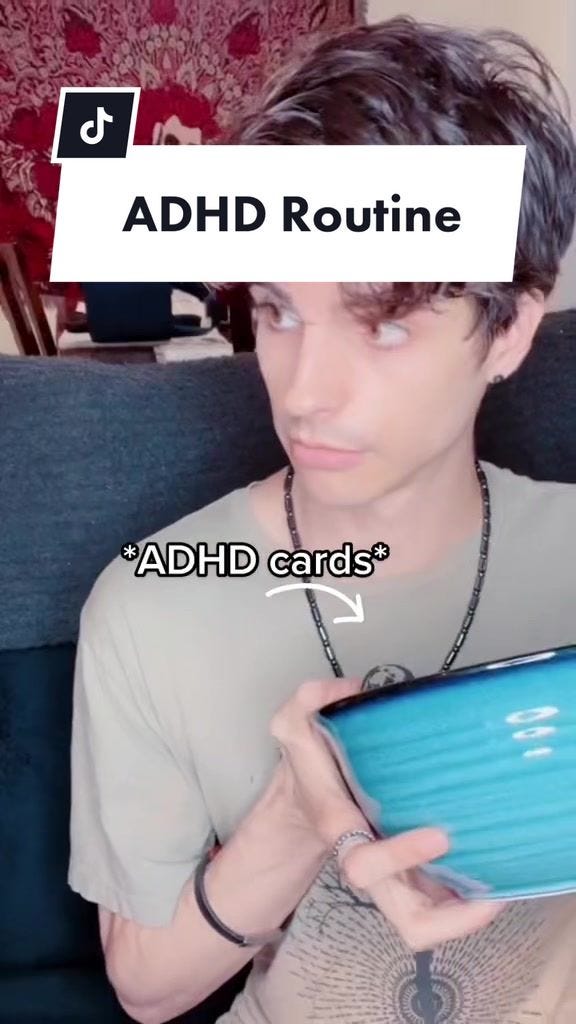
This video also explains it really well, if you prefer a visual.
 Tiktok failed to load.
Enable 3rd party cookies or use another browser
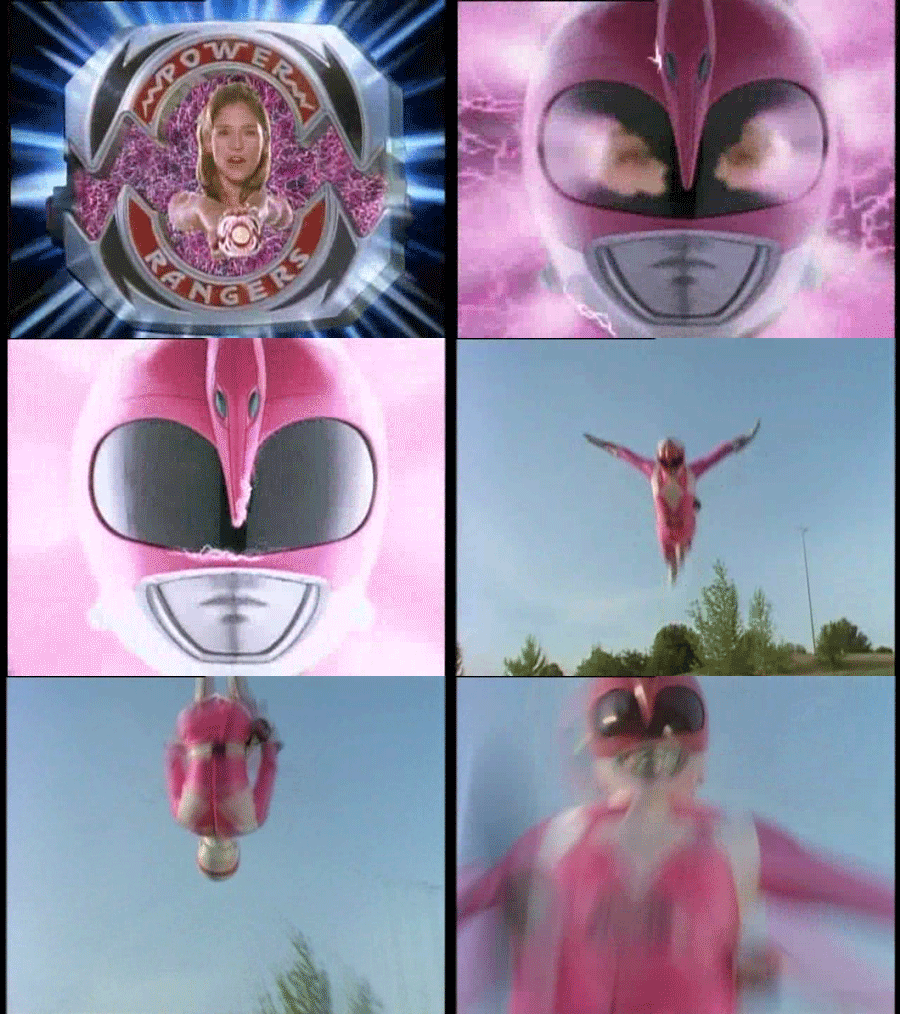
This isn’t the first time I created an alter ego. In grade school, I got in trouble for something homework-related. In order to get my work done, I created a new persona, Kimberly, and did my homework as her. I played ‘school’ at home, pretending I was Kimberly. Kimberly had great handwriting and neat notebooks. Kimberly used a fuzzy pink pencil.
I even wrote the name ‘Kimberly’ at the top of my homework. Now, this is a ~25-year-old memory, so I don’t know if I handed this in or if this was practice homework, so bear with me. But I do know that, as Kimberly, my handwriting was impeccable. I finished my homework early, put it neatly in a folder, and moved on with my day.
One night in 8th grade, while not studying for a history test the next day, I looked at the stack of flashcards, wondering why I couldn’t bring myself to flip through them. Without studying, I knew I could probably get a B+, maybe even an A-. But for some reason, the memory of Kimberly popped into my head. Kimberly would study, I thought.
And so I studied. And so I got a 99% on that test. Is that how easy it is to get good grades? I remember thinking.
The next ~8 years of school would prove that statement right and wrong. If I just applied myself, I thought, this is easy. I just couldn’t understand why applying myself was so difficult. Kimberly lost her name over time, but whenever I needed to really buckle down, I would think what would they do? They, being whichever type-A, good-student friend or peer that popped into my head that day.
And so I would do what they’d do; I’d write the paper, I’d make the study guide, and the gains were there.
I’m making it sound much simpler than it was. Because for every success, there was also an all-nighter, a paper that fell just short of the length it needed to be, for an email sent to a professor humbly asking for an extra 4 to 24 hours to finish something I knew I had more than enough time to do.
A big part of what I get hung up on as a person with ADHD is not just the languishing between tasks and the inability to ‘get up and do it,’ as Anna says, but the ensuing guilt that follows.
So why does this happen?
For most humans, in order to get something done we start with the intention to do it. The space between that intention and actually doing it is where our motivation lives.
An analogy I love to use to describe this comes from How to ADHD’s theory on ‘Motivation Bridge’.
Her theory is that motivation is just a bridge between intent and doing. We all have this bridge, and our bridge is made up of various planks to help us get there. All bridges have gaps — even the most type-A, neurotypical person you can think of doesn’t have perfect motivation all of the time.
But those of us with ADHD have bigger gaps in our bridges. Like, half the bridge is missing. Finishing something can be just as important to us as it is to a neurotypical person on the bridge next to us. We can try as hard as we can, but if the planks aren’t there to physically support us, it’s not going to happen.
In the following video, Jessica explains this theory better than I did and goes on to talk about how to add more planks. I highly recommend giving it a watch.
We can build planks as long as they are stimulating. Which is why the idea of creating an alter ego is so appealing.
And so, I’m bringing Kimberly back. Kind of.
Last year, I wrote about being in my ‘Just Do It’ era. Of wanting something and going for it. I think I’ve done a pretty good job at that, at least professionally.
Yummy Dopamine: Entering my 'Just Do It' Era

“I wrote a book,” my friend announced in our group chat one day.
I got a job, quit a job, started a podcast, started a paid series on my Substack, signed a new freelance client, and much, much more in the last six months.
Part of ‘being cringe’, I find, almost requires me to dissociate from my body a bit. To take a birds-eye view and detach from what I’m doing. To observe as if it’s someone else.
But I still get stuck. Laundry piles up, I procrastinate the dishes, and I put off a run for too long that I end up skipping it. I do my freelance work at the last minute more often than not. The possibilities and to-dos on my list feel endless, and so I stand there, like a Roomba, and sometimes accomplish nothing.
So now, I’m going to actively name my alter ego and bring her in to help.
Kimberly doesn’t worry about making the perfect choice. If there’s laundry to fold and dishes to be done, she just picks one.
I’ll be thinking about Kimberly in the moments where the dirty water bottle would be enough to keep me home from the gym (but also thinking about her in the moments where I bring the water bottle home and decide whether or not to wash it right away). I think about what she’s allowed me to do so far, and where that will take me.
Armed with awareness (and medication), life has gotten easier. I have the tools to get things done, even when all of my planks from Motivation Bridge have gone missing.
Tools will never cure me, even this one, who’s been with me for longer than I knew I needed ‘tools’. The novelty may wear off (it will). But it’s a tool in the box, a plank for the bridge, and one more thing I can try when I’ve had enough of those damn Pomodoro timers. When I feel stuck, I can think, ‘What would Kimberly do?’
And I’ll tell you what — Kimberly would finally get caught up on the damn laundry.
One day = almost a year ago, because I have been sitting on this one for a long time.
An aside: I carry a bit of resentment about this, and I’ve worked through and am working through this, but I particularly have had a hard time forgiving a few of my former teachers and school administrators I encountered when I was in school, when my undiagnosed ADHD was, in hindsight, the most obvious. There’s also guilt for what I couldn’t do, and sadness for the person I could’ve been but will never know.
But, that’s not what this essay is…maybe one day.
The more I read about ADHD, the more I suspect I have ADHD. Your actual gym sequence is one of the reasons I do not/cannot go to the gym.
Kimberly the pink ranger was ALSO my hero!
"shit -- that's now" I cackled! This was so relatable.