

Why I Can't *Just* Be a Product Manager Anymore
For everyone who has ever felt like their career was mostly, but not quite, the right fit

Welcome to All of the Above, a place where Generalists, folks-of-all-trades, and the wearers of many hats are finally at home. In this column, I explore how those of us who do it all (and love to do it all) can make it work in a world that is obsessed with fitting us into boxes.
After my last layoff1 last summer, I have a distinct memory of looking at the Product jobs on LinkedIn and feeling a pit in my stomach. I don’t want to do that, I thought, or that, or that, or that.
Did I even want to be a Product Manager anymore?
While I was sorting through that very question, I wrote an essay originally titled I don’t want to be a Product Manager anymore, later titled I might not want to be a Product Manager anymore. I never ended up publishing that essay — I probably didn’t want to say those out loud, because there was something I really loved about Product work. Today, I am revisiting that topic with a new perspective.
It’s not that I don’t ever want to be a PM, it’s that at this point in my life, I don’t just want to be a PM. It’s a role that requires you to wear a lot of hats, but it still boxes me in. I’m not only ready to say that, but I’m ready to publish that.
But back then, I wasn’t. I wasn’t ready to close the door, even though I knew in my gut a traditional PM role just wasn’t aligned with what I wanted.

But I felt like I’d worked so hard for that career, and there was still more to do. I wanted the ‘Senior’ tacked on to my title (badly). I had — and still have — this deep desire to solve problems for people, and I became a PM because I think software is a compelling way to do that. I’d placed a target on that title early in my career, told myself, ‘I think I’d like to do that one day,’ and let my career unfold. And eventually, five years after that initial thought, I was stepping into a Product role.
PMs will tell you “Product is different everywhere,” and that’s true, but it’s also an established discipline. There are books written about it, ‘rules’ and best practices to follow, podcasts and newsletters about it, and most importantly, it’s a specific title that, when you see it, you more or less know what to expect.
So when, after five years, I realized there was a chance I wanted to forgo the title and career I worked hard for and that finally helped me fit into a neat box, I’ll admit it — I was scared.
I realized there was a lot about Product work I liked, but also a lot about the work I didn’t like. And there was also a lot of experience I had before becoming a PM, leveraging skills I liked leveraging, that I felt like I wasn’t using anymore (or when I tried to use them, that I faced resistance).
Last summer, while laid off, I joined a Job Search Council after reading the book Never Search Alone. I met weekly with other folks looking for employment, and part of the program is creating a detailed two-pager that takes your strengths, likes, dislikes, and market-fit into account.
While working through this exercise, I started to face the reality that a lot of the things I ‘liked’ and ‘disliked’ didn’t quite match a traditional PM job description. I started to say things like “I want to maybe explore other paths while I also look at Product jobs,” but had never allowed myself to say “I don’t want to be a Product Manager anymore”, even if that is what I had felt.
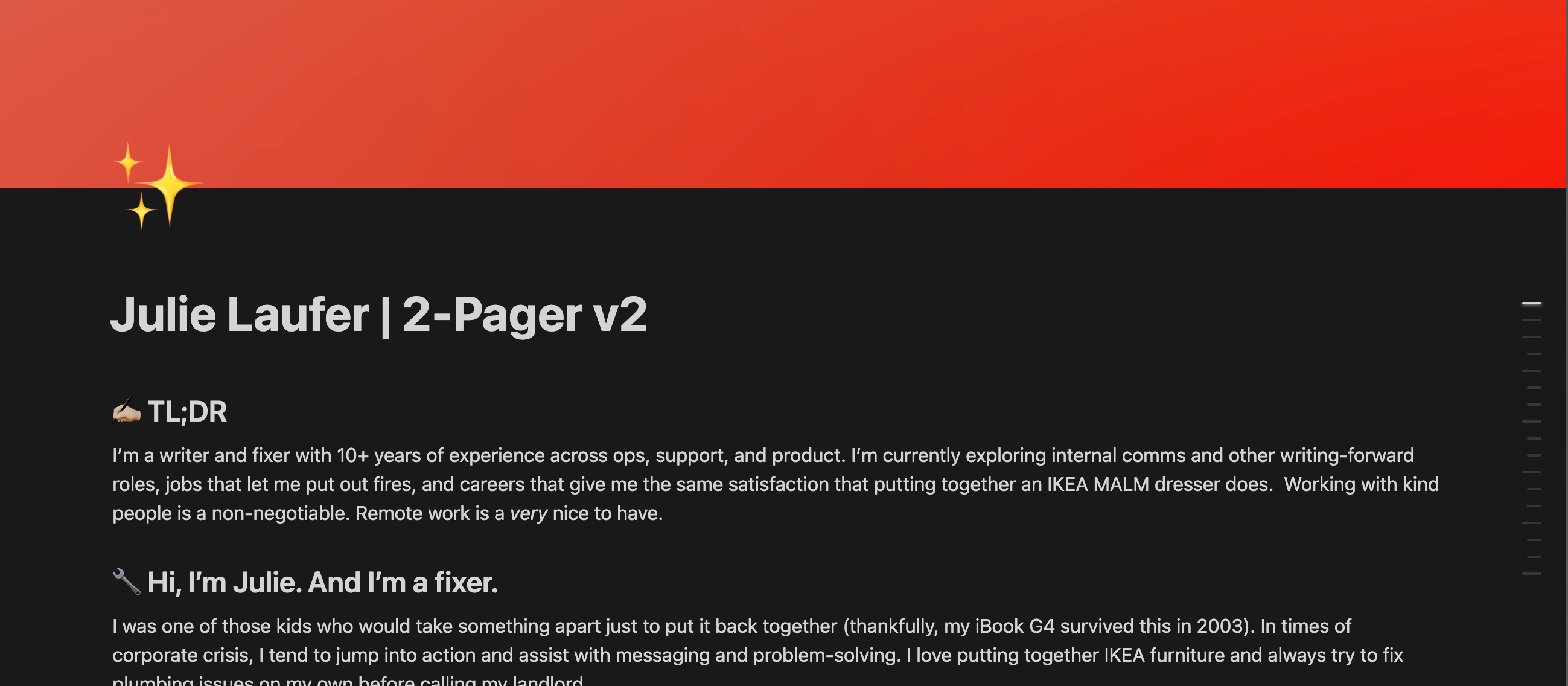
During a round of revisions, someone on my council noted that everything in my “Strengths” section were very ‘PM-coded’, and pushed me to think of whether I had other strengths (spoiler: I did). Even as I was trying to push myself outside of my box, I found it difficult to actually do so until I was given permission by someone else.
I think I am a decent PM, but is ‘decent’ enough to build my career on? That’s the wrong question, because yes, it is enough. But I, maybe unfortunately, want more than just doing something I’m good at.
When I started actually mapping what I liked and didn’t like, a pattern emerged that had nothing to do with Product, though I think it’s part of what helped me in those roles. I like people, writing, fixing things, and seeing how all the pieces fit together when no one else can. I like the early stages of a problem — whether it’s a user problem, a need for operational improvements, or an issue within a team, working incredibly cross-functionally, and I like making language say exactly what it needs to. What I don’t love is being judged entirely on outcomes I can’t fully control, doing everything right and having it not matter because the numbers didn’t move, and living and breathing data analysis.
None of that is inherent to Product work, but it’s also not not Product work. It doesn’t quite fit in a box, and if it does, I haven’t found the right box yet.
So where does this leave me? On paper, I'm doing this backwards. I quit my job, and now I'm figuring it out. If I were giving responsible advice, it wouldn't be that.
But the first thing I needed to do was to take a step back. Having clarity on what I want and don’t want is a great step, too, but the space between my full-time product role and what I have now is necessary. You might argue that I had this back in June, but I needed to choose this.

What I do know is that being a fixer is at the core of what I want to do. I like seeing what’s a bit messy and helping make sense of it (whether that’s in a product, on a team, or apparently, in my own career).
So far, I haven’t seen any roles on LinkedIn for ‘Fixer,’ and I believe that’s by design. The work I want to do at this time isn’t joining an organization full-time. The problems I want to solve shouldn’t be problems forever, but rather something I can shape and send off to its permanent home when it’s all fixed.
Leveraging the skills in Product, ops, and working with teams in customer-facing roles will lead me down the right path. After all, there’s a lot in those domains I enjoy, and that is where my experience is — the next step is to figure out how to do that on my own terms. That’s the ticket to success.
I know I am not the only one who’s spent far too long chasing titles and a linear career path only to find that it mostly, but not quite, fits. That is, after all, the plight of the generalist.
Next week, I’ll be sharing more about that plight with a wider aperture. If that is you and you have something to share — a feeling, advice for others, a question you’re wrestling with, or advice you need — I’d love to hear it below, and perhaps share it in next week’s issue of All of the Above.
I’ve written a lot about my feelings and experiences with layoffs — I’ve been laid off three times, my husband twice, and now we’re both self-employed. If you want more on that, the linked collection is for you.
Thanks for sharing Julie. I've been speaking to a guy who has been assigned to as my coach* and one of the things I've asked for us to explore is 'career clarity', in that, I have no idea what's next and little clarity into what's next. I know what I'm decent at but is that enough to build a career out of? There are things that I like but do I like them because I'm good at them... or am I good at them because I like them? There are things I don't like. Those are pretty straightforward, but I know I have a lot of resilience for them, so maybe they're okay so long as they're not the core activity? The term 'Product Manager' had popped up on my mind a ton as something to go into but as you say, product is different wherever you go, in its level of ownership, in how much influence you have, in what's actually on your screen on most days -- so really, I've got no idea too, but maybe through these conversations and learning about stories like your own, I can gain a bit of that clarity :))))
Life can be weird sometimes. One day you have your career planned out. Everything is right there at your fingertips. But your health comes up and you have to sit down and re-think your path in life. So the questioning of what you are doing and what you really like, is something I understand.